
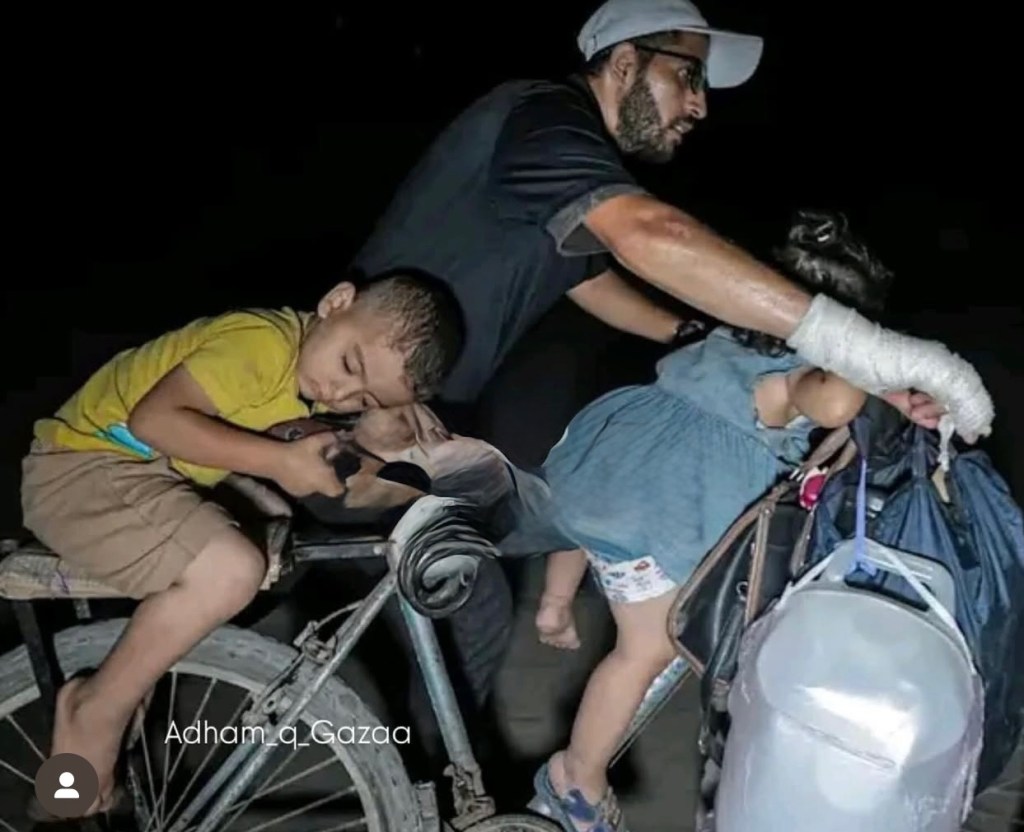
It begins with a WhatsApp ding.
A fragile sound. A lifeline stretched across continents.
Hany messages me at 4 a.m. Gaza time—8 p.m. for me.
He was a math teacher before the war, a father of three. He is my most consistent communicator, my compass in the dark. His messages are raw:
“There was a violent attack. All kinds of weapons. The children are finally asleep… but I can’t sleep.”
He tells me they hold their shoes when they run in the night. He tells me he fears losing his home. He tells me he thinks about the unknown.
Later, a message from Brahima—19 years old, once a scholarship student studying to be a physical therapist. Now she carries water between tents and messages me when she feels
scared.
“It’s a very scary night,” she writes. “So many sounds.”
The connection drops.
Hours pass.
The drones hum.
Then:
“Sister, I’m here. I’m sorry for the outage.”
She asks if she can video call me just to feel I’m near.
And then there is Ahmed—the music therapist, the one whose drone song went viral. When he sends me a video of the children huddled inside a cold tent, he writes:
“We are not safe, Michelle. Even if missiles spare us, there is no medicine.”
He tells me of depression creeping in. Of mattresses sinking in rainwater. Of longing to pray in a mosque again. Of grieving his old life.
But he also speaks of joy, of memory, of music.
Because even in genocide, the human heart reaches for connection.
These threads—thin, fragile, luminous—are what keep them going.
And, in their own way, what keep me going too.
 Earth Angels Act
Leave a comment